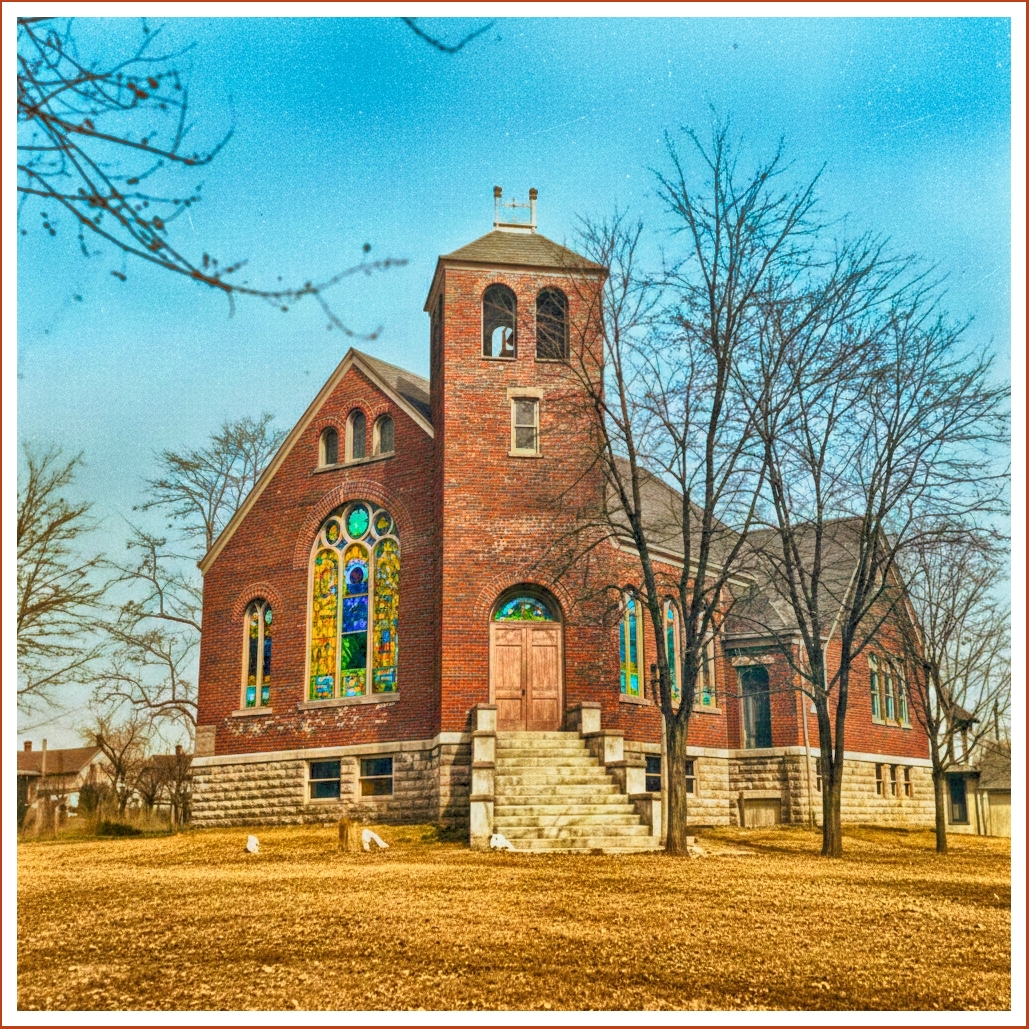
First Universalist Church, Cuba, Ohio
[1911 - Colorized]
Cuba Universalist ChurchCuba, Ohio
(Clinton County)
(Clinton County)
Organized: 1868
Dissolved: Late 1930s, early 1940s (?)
First Church Location: SE corner of C and E (Main) St.
Second Church : Same Location (?)
Sometimes with historical research you get lucky. Sometimes you don’t. And sometimes there is a plethora of facts. The only problem is the beginning and the ending. And such it is with the Universalist Church in Cuba. Hopefully some day someone will be rummaging through an ancient file cabinet stuff with papers, or an old dusty truck, look at some papers and say, “Ah Ha!
Meanwhile we do the best with what we do have.
The Antecedents
Elmo Arnold Robinson in his go-to book for early Ohio Universalist history – The Universalist Church in Ohio – simply says that a Universalist society was organized in Cuba in 1868, and that a church was built in 1870. In between they worshipped in the school house.1
But—societies and churches just don’t happen. There has to be history that precedes, and that unfortunately is not documented. In 1915 Albert Brown notes that church documents are missing, incomplete and sometimes contradicting.2
Robinson does throw in one nugget though. When speaking of the Society in East Fork, fellowshipped by the Ballou Association in 1846, adds, “See Cuba.”3
We’ll come back to that, but before we do, we take note of the Moon Clan who, if stories can be believed, were as thick as a blackberry patch throughout Clinton County.4 Joseph, his wife and children settled near Martinsville in 1809. In time, the moons, a devout Quaker family had ten son, numerous grandchildren, plus they were joined by seemingly countless relatives. Over the years some of these Moons became Universalists, other than a different form of worship, not a major conversion. We find William R. Moon, Martin H. Moon, Emily H. Moon and Sallie Moon among the first members of the Society.
Many if not most of those who came from Virginia and the South to settle in Clinton County were Quakers. It is not unreasonable to assume that some them also converted over time to Universalism.
Retuning to the East Fork Universalist Society, we are required to make some educated guesses. East Fork was about nine miles south of Cuba. Some old maps show it as East Fork Toddfork. Early histories have the community extending several miles up the East Fork of Toddfork of the Little Miami River. Took me a while to figure that one out.
East Fork may or may have been formed by some Universalists left behind by the earlier Toddsfolk (Toddfork) when it relocated to Edwardsville (1839), and then to Blanchester (1852), becoming the First Universalist Church. The earlier Toddsfolk was established sometime prior to 1835.
Whatever the actual story, we do find a Universalist Society organized and fellowshipped by the Ballou Association.
In 1857 the railroad arrived in Cuba. The citizens of Cuba took an active interest in seeing that the railroad came through their town. Part of that was recruiting new residents. It is not a far stretch of the imagination to assume that many of the East Fork folk moved to Cuba to be closer to the railroad, bringing their society with them.
Lastly, while there are no supporting records, I think we could safely add the establishment of a church in Cuba was supported by Blanchester and other established area Universalist Churches.
Cuba Universalist Church
While the full story of the beginning of the Cuba Universalist Church may never be known, we do know that it was organized as part of Ballou Association on November 29, 1868. The Rev. William S. Bacon was the organizing pastor. Early services were held in the Cuba schoolhouse until a church was built in 1870.
The next minister of note was the Rev. John Richardson who held the pulpit from 1883 to 1887. The Universalist notes that in fall in ’87 “after a long and successful pastorate” Rev. Richardson served notice that he was going to accept a call to a different church. The Ballou Association suggests that Cuba and nearby Farmer’s Station share a minister.5 From the extant records it appears that the two churches over the years shared ministers and cosponsored “Gove Meetings.” One such meeting is recorded by the Universalist as being held in August, 1895.6
In April of 1895 Rev. Richardson returned to the church to assist in the establishment of a Sunday School Union. The attempt is successful, with a strong Sunday School lasting well into the 1920s. Prior to the return of Rev. Richardson, in 1894 the church was remodeled and a parsonage built.7
On Christmas Eve of 1894 the church presented an original play, “The Widow’s Meal Barrow.”8 On Christmas Day the play was performed at the First Universalist Church of Springboro.
Rev. Richardson served until 1897, and perhaps retuned for a short time in 1903.
In 1909 a new “beautiful and commodious church” was built (in picture). It was dedicated in late fall; the R. S. Kellerman preached the dedicatory sermon.9 Rev. Kellerman pastored the church between 1910 and 1912. Following Kellerman, three pastors served the church until the fall of 1914. The last regular pastor for several years following was Rev. Sara L. Stoner who abruptly resigned after just a few months in pulpit.
During the early years of the church the Ballou association held their annual convention at the church in 1890, 1897, 1909, 1914. It appears that the 1896 convention, originally scheduled for Cuba was moved to Blanchester due to a diphtheria outbreak in Cuba.
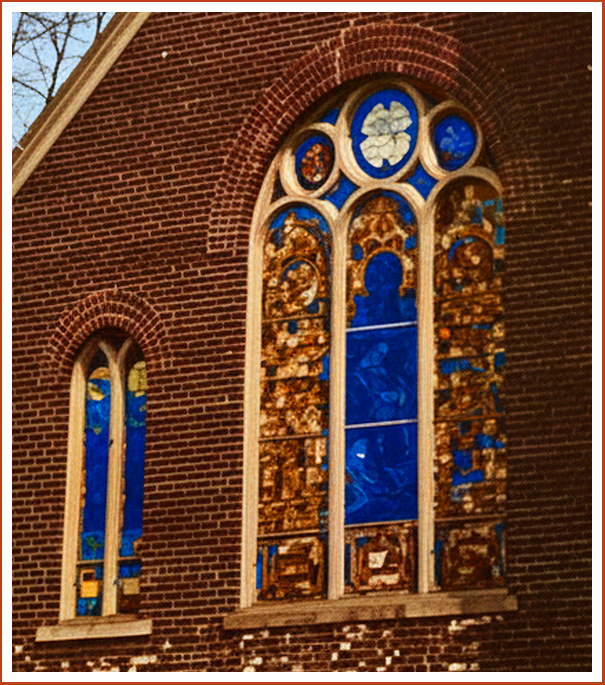
Stained Glass Windows
[1911 - Colorized]
The Empty Years
During the years between the building of the new church and the resignation of Rev. Stoner in 1914 the congregation was an active one, holding not only worship services, but also hosting community cultural and political events. However, after 1914 the church seems to have all but disappeared as an active entity. There is the occasional note in local papers of a guest preacher, and it appears that the church stayed on the roles.
On May 19, 1916, the Simth & Clevenger Law Firm filed papers in Clinton County Common Pleas Court, on behalf of the congregation to dissolve and sell its real estate.

Notice of court Filing
Around 1921 an effort was made to renew the church, an effort that brought the 1921 Ballou Association convention to the Cuba church.
“A Most Successful Church Plant”
The petition must have been withdrawn, or perhaps there was no subsequent sale. In November, 1923 the church is once again functioning—as a renewed society. The Universalist Leader called it “one of the successful church plants.”11
The effort to renew the church was primarily carried by the Blanchester Church and her minister, Rev. W. R. Roland, probably with some assistance from the Ballou Association. In the same issue of the Universalist Leader, we read that with the renewed church came a “redecorated church,” including the exterior, Sunday School classrooms, sanctuary and the social area in the basement. The dedication celebration lasted eight days, from the 13th to the 20th, with dedication sermon delivered by Rev. Roland on the 17th. The week-long festivities included sermons, music, meals (undoubtedly furnished by the ladies of both churches) and other activities. Attendees were from nearby Universalist churches, well as the larger community.
The Final Years
Perhaps it was the timing? Not long after the plant, Cuba never a very large town, and unincorporated, began to decline. The Stock Market crash of 1929 only hastened the decline. By 1933 the railroad had ceased serving Cuba. With all of that, it was only inevitable that the church would also decline.
I have been unable to find a date when the church closed, or even what happened to it. I am working on it. The lot sits vacant. It does appear however to have last until 1930s, perhaps a bit longer.
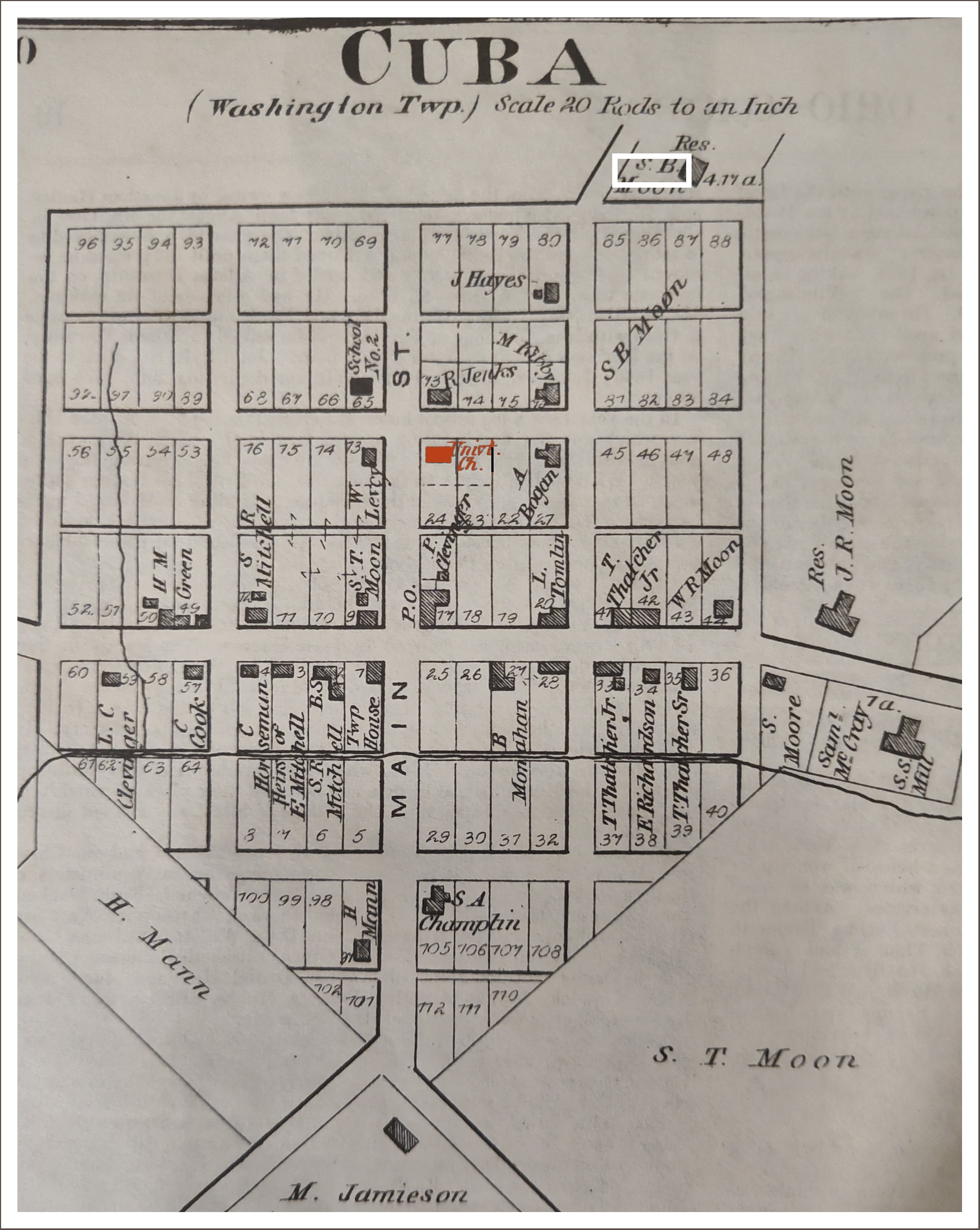
1876 Platt Map, Cuba, OH
Church location in red
Notes:
1. Robinson, Elmo Arnold. The Universalist Church in Ohio (1923). p.147,
2. Brown. Albert. The History of Clinton County Ohio: Its People, Industries and Institutions (1915). p.
3. Robinson. Ibid. p.148.
4. Clinton Republican, Wilmington, OH, 12.24.1868.
5. Universalist, Cincinnati, 27 November 1897.
6. Ibid. Universalist. 17 August 1895.
7.Robinson. Ibid. p. 147.
8. “The Widow’s Meal Barrow,” is based on biblical story of Elijah and the Widow of Zarephath found in 1 Kings 17. Supposedly, the Cuba Universalist Church was the first to perform it. The playwright is not recorded. The Universalist, 5 January 1895.
9. Clinton County Democrat, Wilmington. 30 September 1909.
10. Sabina New Record, Sabina, OH. 25 May 1916.
11. Universalist Leader, Boston. 17 November 1923. The Universalist Leader was the national paper, published by the Universalist Convention, Boston.
Resources:
Blanchester Historical Society.
Brown, Albert, The History of Clinton County Ohio: Its People, Industries and Institutions (1915).
Clinton County Democrat, Wilmington, OH.
Clinton County Historical Society.
Clinton Republican, Wilmington, OH.
Harvard Divinity School Library, Universalist Archives.
Lake, Griffing & Stevenson, The Illustrated Atlas of Clinton County (1876).
Robinson, Elmo Arnold,em>The Universalist Church in Ohio (1923).
Sabina New Record, Sabina, OH.
Universalist,Cincinnati.
Universalist Leader, Boston.
Images of Church:
Blanchester Historical Society (Postcard dated 1911, photo, colorized by me.)