A Happy Calvinism
1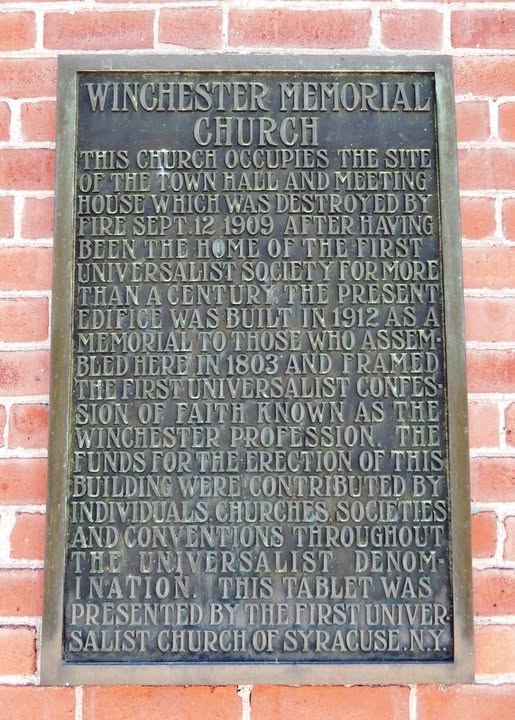
Winchester Confession Historic Marker, Winchester, MA.
Most of us know that the Universalist Church was rooted in Christianity. You only have to look at the Winchester Profession to see that.2 What many of us do not realize is that American Universalism is also rooted in Calvinism. Not a rejection of Calvinism, but rather a reformation of Calvinism.
Universalism took hold in New England, among Congregationalist—thoroughly Calvinistic. Universalism held to the Calvinistic notion that God was the absolute ruler of everything. It held too, to the idea that God is experienced primarily through nature, and that one is fully dependent upon God for every moment of existence.
Universalism, while not denying the doctrine of Election, held that all are elected by God for salvation. Rather than the harsh and arbitrative God of Calvinism, God was above all else, Love. A benevolent, loving parent who would save everyone. Universalism as someone has said, is a “Happy Calvinism.”
“God is Love”—because of the divine’s love, salvation is the free gift from a loving God to all of humanity (and nature). Universalism maintained Calvinism’s premise that salvation cannot be earned through one’s own merit, but through God alone. As Hosea Ballou said, “Salvation is irrespective of character.”3
This sort of Happy Calvinism appealed to those scratching out a living on the edges of civilization and the frontier wilderness.4 These folk experienced God in nature every day.V
As Universalism took hold, the idea that God is love, became more of a mantra than a motto.
If God is love, then God wants everyone to sense the deep fulfillment that comes with being fully loved. And the way to sense that deep fulfillment is to strive to live a moral life after the way of Jesus, as it was Jesus who demonstrated the fullness of God’s love. If one does so, then one will experience that sense of deep fulfillment. And as one begins to experience that fulfillment, that love impels them to share that deep sense of fulfillment with others, both in deed and word. It is the task of both individuals and the church to help people learn to fulfill the nature God has given them.

1. I want to acknowledge the essay “We Don't Know Our History,” by the Rev. Richard Trudeau in the September 2026 issue of UUnderworld, p. 138. It was this essay that prompted me to write this piece. My apologies to Rev. Trudeau when my words sound like his words.
2. Winchester Profession (1803)
Article I. We believe that the Holy Scriptures of the Old and New Testament contain a revelation of the character of God, and of the duty, interest and final destination of mankind.
Article II. We believe that there is one God, whose nature is Love, revealed in one Lord Jesus Christ, by one Holy Spirit of Grace, who will finally restore the whole family of mankind to holiness and happiness.
Article III. We believe that holiness and true happiness are inseparably connected, and that believers ought to be careful to maintain order and practice good works; for these things are good and profitable unto men.
3. Hosea Ballou in Trumpet and Universalist Magazine, XXII (August 18, 1849)
4. Such as the early Universalist folk here in Ohio who worshiped God and built churches for corporate worship.
Frank
Sheffield Lake, OH
Sept 6, 2026